G.T Road Khanna-141401, Punjab, India
- Talk to Us +91 99 8857 5151
- Mail Us Info@gopalsteelwork.com





Steel channels play a critical role in India’s structural and industrial development. From large infrastructure projects to industrial fabrication and warehouse construction, steel channels provide strength, stability, and load-bearing support. As demand for durable and high-performance structural steel continues to grow, choosing a reliable steel channel manufacturer in India becomes essential for ensuring quality and long-term performance.
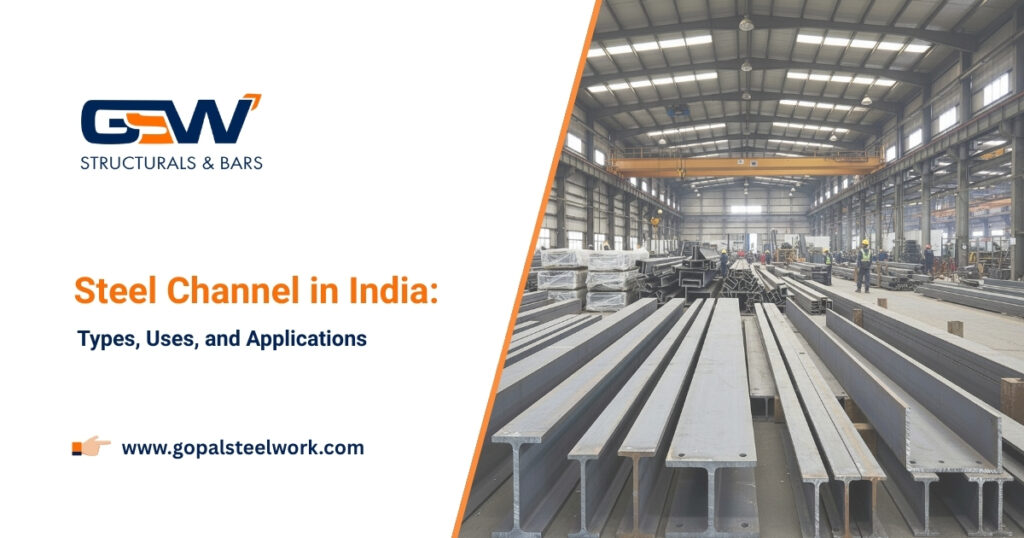
This blog explores the types of steel channels available in India, their major uses, and their wide-ranging applications across industries.
A steel channel is a structural steel section shaped like the letter “C” or “U.” It consists of a web (the vertical section) and two flanges (horizontal sides), which provide strength and resistance to bending.
Steel channels are designed to support loads along one direction, making them highly suitable for structural frameworks and industrial applications. They are widely used due to their strength-to-weight ratio, durability, and fabrication flexibility.
This is the most common type of steel channel used in construction and structural projects. It provides uniform strength and is widely used in building frames and support structures.
U channels are similar in shape but may vary slightly in flange design. They are commonly used in fabrication, machinery frames, and reinforcement applications.
MS channels are the most widely used structural channels in India. They are preferred for their weldability, machinability, and cost-effectiveness.
Some projects require channels in specific dimensions or thicknesses. A professional steel channel manufacturer in India can supply customized sections based on engineering requirements.
Steel channels are used in both heavy structural and light fabrication work. Their design allows them to resist bending and provide directional strength.
Common uses include:
Their ability to carry loads efficiently makes them indispensable in structural design.
Steel channels are widely used in residential buildings, commercial complexes, bridges, and industrial sheds. They serve as structural supports, columns, and reinforcement members.
Manufacturing plants use steel channels for conveyor systems, equipment frames, safety structures, and heavy-duty platforms.
In power plants, substations, and solar installations, steel channels are used for mounting systems, support frames, and structural platforms.
Steel channels are used in truck bodies, railway components, trailers, and warehouse structures where strength and load capacity are critical.
The performance of a steel channel depends heavily on manufacturing precision and material quality. A reliable steel channel manufacturer in India ensures:
High-quality manufacturing reduces structural risks, improves fabrication efficiency, and enhances overall project durability.
Conclusion
Steel channels remain a foundational component in India’s construction, industrial, and infrastructure sectors. Their strength, adaptability, and structural efficiency make them a preferred choice across multiple industries.
As projects become more demanding and technically advanced, selecting a dependable steel channel manufacturer in India is essential to ensure structural reliability, safety, and long-term performance.
